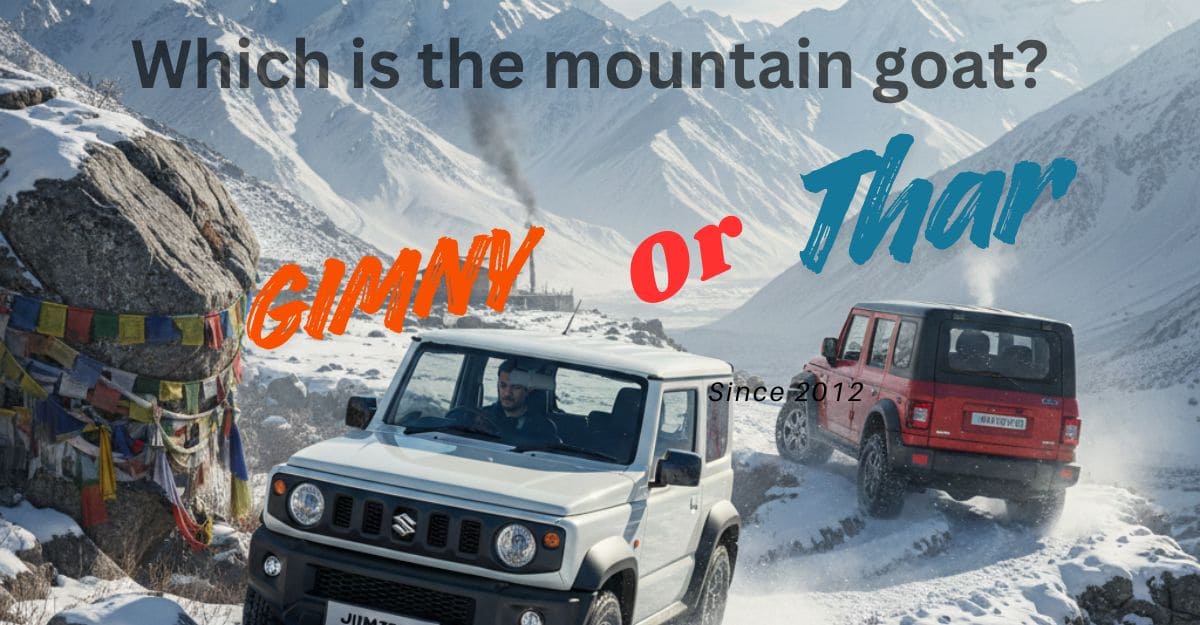
In the rugged landscapes of India, Nepal, and Bhutan, off-roading isn’t just a hobby—it’s a way of life. When the tarmac ends and the mud begins, two names dominate the conversation: the Mahindra Thar and the Maruti Suzuki Jimny.
While the Thar is often celebrated for its “macho” road presence and raw power, a growing community of hardcore enthusiasts is realizing a surprising truth: for technical off-roading, the Maruti Suzuki Jimny is often the superior choice.
If you are planning to buy a 4×4 in 2026, here is why the Jimny—affectionately known as the “Mountain Goat”—trumps the Thar when things get dirty.
1. The Power of “Light” (Weight Matters!)
The biggest enemy of any off-roader is weight. The Mahindra Thar is a heavy beast, tipping the scales at nearly 1,750 kg. In contrast, the Jimny is a featherweight at roughly 1,200 kg.
Why does this matter?
- Float over mud: While the heavy Thar might sink into soft sand or deep slush, the lightweight Jimny “walks” over it.
- Easier Recovery: If you get stuck, pulling out a 1.2-ton Jimny is significantly easier than winching a nearly 2-ton Thar.
- Momentum: In the mountains of Himachal or the narrow trails of Nepal, a lighter car requires less stress on the engine to climb steep, loose inclines.
2. Narrow Body: The “Fit-Anywhere” Advantage
India’s off-road trails and Himalayan backroads share one common trait: they are incredibly narrow. The Mahindra Thar is wide and muscular, which looks great in the city but becomes a liability on a cliff-side trail.
The Jimny’s slim profile allows it to:
- Navigate Tight Gaps: It can squeeze between trees or rocks where the Thar would be forced to stop or risk a dent.
- Better Visibility: The Jimny’s boxy design and upright pillars mean you know exactly where your wheels are at all times. In off-roading, precision beats power every single time.
3. Superior Off-Road Geometry
While the Thar has higher ground clearance (226mm vs the Jimny’s 210mm), ground clearance isn’t the only metric that matters. You have to look at the Angles of Approach, Departure, and Breakover.
| Feature | Maruti Jimny | Mahindra Thar (3-Door) |
| Approach Angle | 36° | 41.2° |
| Departure Angle | 47° | 36° |
| Ramp Breakover | 24° | 26.2° |
The Jimny’s 47° Departure Angle is world-class. It means you can climb down a steep rock or out of a deep ditch without ever scraping your rear bumper—a common issue for Thar owners.
4. The Legendary Solid Axle Suspension
The Mahindra Thar uses an Independent Front Suspension (IFS). This makes it comfortable on highways but limits “wheel articulation” (how much the wheels can move up and down) on rocks.
The Jimny uses 3-link rigid scratch-resistant solid axles both at the front and rear.
The Pro Secret: When one wheel on a solid axle is pushed up by a rock, the axle naturally pushes the other wheel down to maintain contact with the ground. This ensures the Jimny keeps traction even on the most uneven surfaces.
5. Reliability: The Peace of Mind Factor
Off-roading often takes you to remote areas like Ladakh, Spiti, or the rural terrains of Bangladesh and Sri Lanka. If something breaks, you need a car that is easy to fix.
- Service Network: Maruti Suzuki has the widest service network in South Asia. You are more likely to find a mechanic who knows a Suzuki engine in a remote village than one who can fix the complex electronics of a modern Mahindra.
- Cold Starts: The Jimny’s 1.5L K-Series naturally aspirated petrol engine is famous for its reliability. Whether it’s -15°C in the mountains or 45°C in the Rajasthan desert, the Jimny starts at the first crank.
6. The 5-Door Practicality
For the longest time, the Thar was a “lifestyle” vehicle—great for two people, but a nightmare for a family. The Jimny comes standard with 5 doors.
You can take your friends, your camping gear, and your dog off-roading without anyone having to crawl into the back seat like an acrobat. It’s a “Practical Off-Roader,” a rare breed in the Indian market.
7. Why gimny is best for these roads and mountains
Zanskar & Spiti: The High-Altitude “Cold Start” Advantage
For the freezing winters of Himachal and Ladakh, the Jimny has a technical edge that many overlook.
- The Cold-Start King: In Zanskar, where temperatures drop to -30°C, diesel engines in the Thar can struggle with “waxing” (where fuel thickens). The Jimny’s 1.5L Naturally Aspirated Petrol engine starts much more reliably in sub-zero conditions.
- Weight on Thin Ice: During the famous Chadar-style crossings or driving over frozen patches in Spiti, the Jimny’s 1,200 kg weight is much safer than the nearly 2-ton Thar. It exerts less pressure on fragile, icy surfaces.
- Momentum vs. Turbo Lag: At 14,000 feet, air is thin. The Thar’s turbocharger can sometimes suffer from “lag” on steep hairpins. The Jimny’s non-turbo engine offers a linear power delivery that helps you maintain steady momentum on the narrow climbs of Kaza and Losar.
Munnar: The Narrow Tea Estate Mastery
Off-roading in South India, specifically the tea estates of Kerala, is a different beast entirely—it’s about mud and tight spaces.
- The “Gap” Specialist: The trails through Munnar’s tea gardens were originally made for narrow tractors and old Jeeps. The Jimny is roughly 175 mm narrower than the Thar. This means the Jimny can slip through narrow rows of tea bushes or between ancient trees where a Thar would be forced to turn back.
- Mud Floating: In the heavy monsoon mud of the Western Ghats, heavy vehicles often dig themselves into a hole. The Jimny’s “light footprint” allows it to skim over the surface of the mud rather than sinking into it.
Real-World Tip: “If you are driving the Munnar-Kolukkumalai route (the highest tea estate in the world), the Jimny’s turning radius of 5.7 meters makes it much easier to handle those 30+ sharp hairpin bends compared to the wider, heavier Mahindra Thar.”
8. Maruti suzuki gimny price
Maruti Suzuki Jimny: The 4×4 for Everyone
The Jimny is often seen as the more “approachable” off-roader. In 2026, Maruti has streamlined the pricing to keep it competitive against the growing compact SUV segment.
- Base Variant (Zeta): Starts at approximately ₹11.00 Lakh to ₹12.30 Lakh (Ex-Showroom).
- Top Variant (Alpha Dual Tone AT): Goes up to ₹14.45 Lakh to ₹14.80 Lakh (Ex-Showroom).
- On-Road Price (Delhi/Bangalore): Expect to pay between ₹13.50 Lakh and ₹18.00 Lakh depending on the city and taxes.
Verdict: Which one should you choose?
If your goal is to look “tough” at a red light in Delhi or Mumbai, the Mahindra Thar is a fantastic choice. It has the presence, the roar, and the brute force.
However, if you are a serious off-roader who wants to explore hidden trails, climb the highest mountain passes, and dance through technical obstacles that leave bigger SUVs struggling, the Maruti Suzuki Jimny is the undisputed king. It’s not about how much power you have; it’s about how you use it.